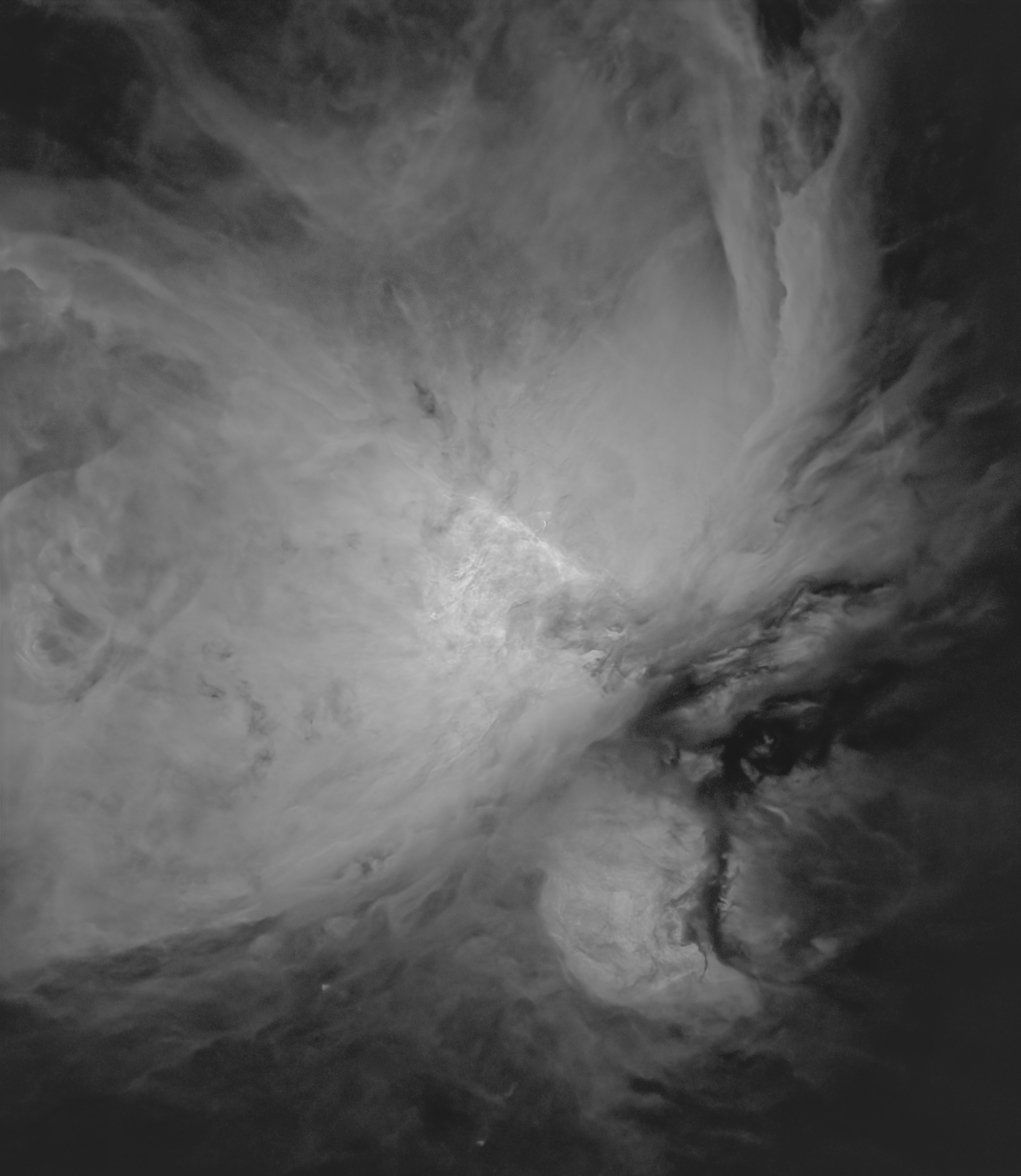
Ionization Structure in the Orion Nebula (M42) Core
Published by Imran Badr on Jan 04, 2026

The Orion Nebula (M42) Core in SHO
The core of the Orion Nebula is one of the most familiar regions in the night sky—and one of the most difficult to image faithfully. Intense ultraviolet radiation from the Trapezium stars creates an extreme dynamic range that often leads to blown-out highlights and flattened structure. This image is a deep narrowband SHO (Sulfur–Hydrogen–Oxygen) study designed to preserve physical meaning rather than visual excess.
In this rendering, emission from oxygen-III (blue) marks the highest-energy regions closest to the massive stars. Hydrogen-alpha (gold) fills much of the nebular volume, revealing folds and texture within the gas. Sulfur-II (red) traces cooler, denser ionization fronts, outlining curved interfaces and bubble-like structures with finite thickness. These sulfur-rich rims are real physical features that are rarely shown clearly in conventional images of Orion’s core.
By carefully balancing the narrowband channels and managing dynamic range, this image reveals ionization stratification and interface morphology in one of the sky’s most studied star-forming regions. Broadband RGB data were used only to restore natural star colors, while all nebular structure and color arise from narrowband emission.
Telescopes: Sky-Watcher Esprit 100ED, Askar FRA300 Pro, Sharpstar 13028HNT
Cameras: 3 × ZWO ASI2600MM Pro
Total Integration: 37 hours 36 minutes
Dates: Jan 2025 - Dec 2025
Software: Pixinight, Photoshop